Equipments
The following equipments wwere purchased as part of the project:
Modular Fluorescence Spectrometer -Horiba
The device is an advanced high-precision optical analysis platform designed for the complex characterization of the luminescent properties of materials, both in solution and in the solid phase (films, powders). Thanks to the fully reflective achromatic optics and the extreme sensitivity (Raman signal-to-noise ratio > 35,000:1), the system covers an extended spectral range, from UV to NIR (up to 1400 nm).
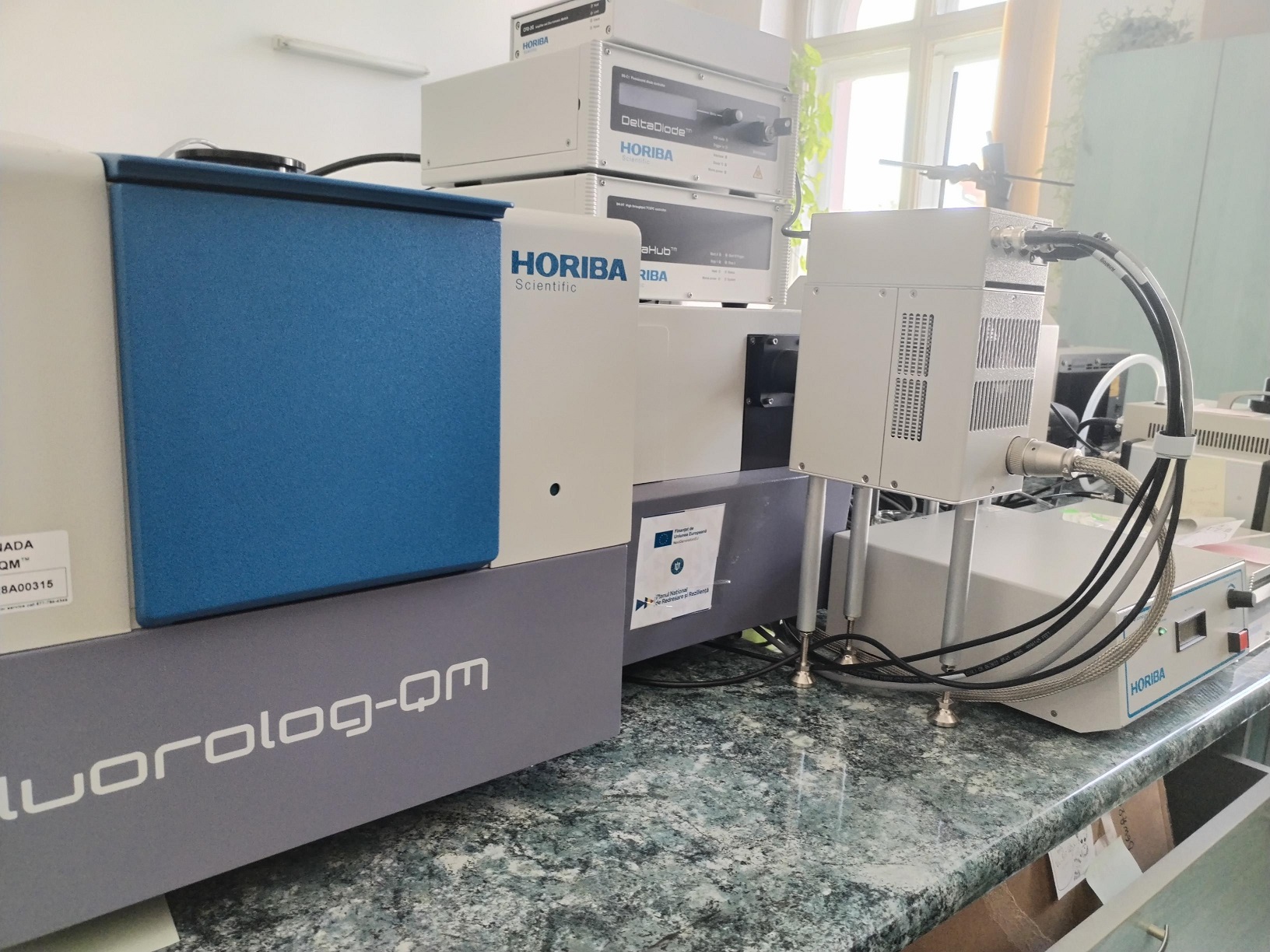
Types of Measurements and Main Capacities:
Steady-State Fluorescence and Phosphorescence: Emission spectra, excitation, 3D maps (EEM) and reaction kinetics.
Lifetime from Picoseconds to Seconds: Time-resolved measurements (TCSPC and Transient Digitizer) for fluorescence and phosphorescence (TRES), using a versatile set of laser diodes and pulsed sources.
Absolute Quantum Efficiency (PLQY & ELQY): Dedicated integrating sphere for photoluminescence and electroluminescence quantum efficiency determination (LEDs, OLEDs, photovoltaic devices), CIE color coordinate calculation and singlet oxygen analysis (1270 nm).
Absorbance / Transmittance: Integrated direct optical measurements.
Fast Kinetics (Stopped-Flow): Dedicated mode for monitoring fast chemical and biological reactions (dead time < 8 ms).
Flexibility and Modularity: Design ready for external connection with optical microscope and compatible with temperature accessories (e.g. analysis at liquid nitrogen temperature).
Electrospinning machine
The electrospinning apparatus is an advanced nanotechnology facility used to obtain continuous polymer nanofibers and microfibers, having an extremely high surface-to-volume ratio and controllable porosity.
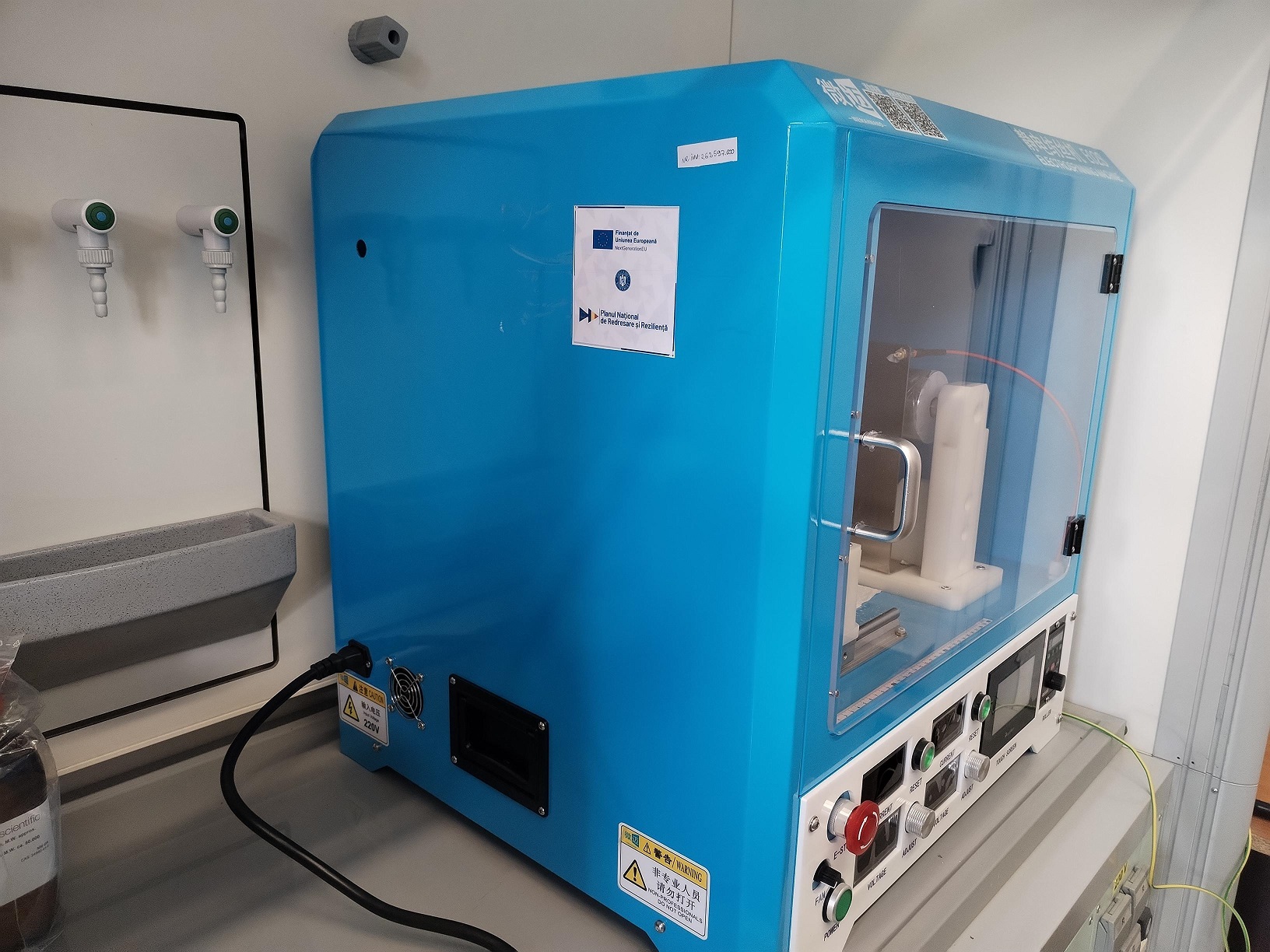
Technical features and advantages:
Versatility - Compatible with a wide range of synthetic polymers, biopolymers (collagen, chitosan, polylactic acid) and nanocomposites.
Controllable morphology - Allows adjustment of fiber diameter and orientation by modifying process parameters (voltage, flow rate, distance from needle and collector) and solution properties (viscosity, conductivity).
Unique membrane properties - High interconnected porosity, large specific surface area and adaptable mechanical properties.
Main areas of applicability:
Medicine and biomedicine: Tissue engineering matrices, controlled drug delivery systems, advanced wound dressings.
Environmental and Filtration Technologies: Water treatment and depollution - Micro, ultra and nanofiltration membranes for the separation of water/oil emulsions, the retention of heavy metals, synthetic dyes and organic micropollutants through absorption or desalination processes (reverse osmosis / membrane distillation).
Biosensors and chemical sensors: Immobilization of enzymes, carbon nanotubes or metal nanoparticles on nanofibers allows ultra-sensitive detection of toxic gases, medical biomarkers or pollutants in ppm/ppb concentrations.