|
|
WORKPLAN
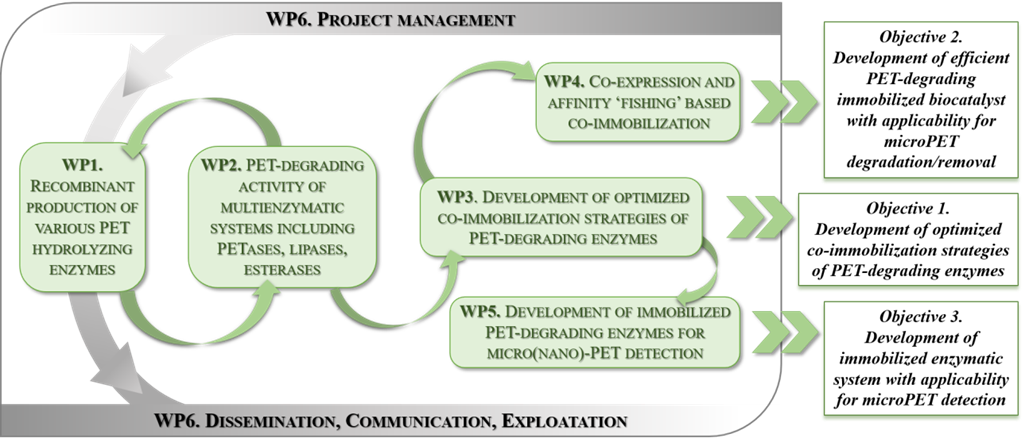
WP1. Recombinant production of various PET hydrolyzing enzymes
(M1-M6)
T1.1. Molecular cloning and site-directed
mutagenesis (M1-M3)
T1.2. Expression, isolation and purification
of PET-hydrolases (M4-M6):
T1.3. Functionality tests of the purified
PET-degrading enzymes (M4-M6)
WP2. PET-degrading activity of
multienzymatic systems including PETases, lipases, and esterases (M3-M12)
T2.1. PET-degrading activity screens for
selection of best performing enzyme mixtures
T2.2. Process optimization for the best
performing enzyme combinations
WP3. Development of optimized co-immobilization strategies of
PET-degrading enzymes (M9-M21)
T3.1. Preparation of functionalized supports
(M9-M14):
T3.2 Immobilization of PET-degrading enzyme
combination with covalent binding and adsorption (M14-M16)
T3.3 Sequential co-immobilization (M17-M18)
T3.4. Co-expression and affinity ‘fishing’
based co-immobilization (M17-M18)
T3.5. Site-specific immobilization version of
the best-perfoming covalent immobilization system
WP4.
Development of immobilized PET-degrading enzymes for micro(nano)-PET removal
(M21-M34)
T4.1.
Testing the microPET-degradation efficiency selected immobilized
multienzymatic systems in batch conditions (M21-M24)
T4.2.
Testing the immobilized multienzymatic systems in continous flow
procedures (M25-M30)
T4.3. Testing the operational stability,
recyclability of the immobilized multienzymatic systems on different
environmental water samples with microplastic content (M31-M34)
WP5. Development of immobilized PET-degrading enzymes for
micro(nano)-PET detection (M21-M36)
T5.1. Fine-tunning the immobilization on
nanosupports (M21-M25):
T5.2. Assembly of multienzymatic microfluidic
systems (M26-M32):
T5.3. Assembly and validation of nanofiber
immobilized multienzymatic systems (M33-M36)
WP6. Project
management including dissemination, communication, exploatation activities
(M1-M36)