|
Objectives |
OBJECTIVES
The project joins the emerging trends of removal of
plastic pollution, targeting to employ the large experience of its research
team in biocatalysis, enzyme immobilization, engineering of enzymatic processes
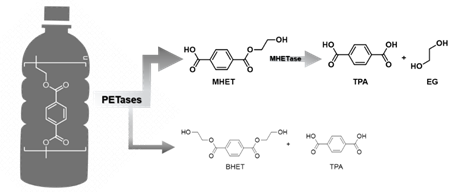
into the field of PET-degrading enzymes. Accordingly, the overall aim of the
project is to develop immobilized multi-enzymatic
systems able to detect and decompose PET microparticle in aqueous environment, through rigorous design and optimization of
procedures included at the level of each main objective:
Objective
1. Development of optimized co-immobilization strategies for PET-degrading
enzymes:
the PET-degrading efficiency of several enzyme
mixtures will allow the selection of the optimal PET-degrading
enzyme-combinations for which various co-immobilization procedures will be
tested, revealing the influence of the nature of
support, linker, enzyme load, reaction medium on the efficiency, stability,
recyclability of the co-immobilized biocatalysts.
Objective
2. Development of efficient PET-degrading immobilized biocatalyst with
applicability for microPET degradation/removal:
several functional co-immobilization strategies of
PET-degrading enzyme combinations, selected based on their cost-efficiency will
be fine-tuned by engineering the immobilization process,
aiming to provide a cheap, recyclable biocatalyst
capable of the removal of microPET from its
water-based solutions in a continuous-flow operation mode.
Objective
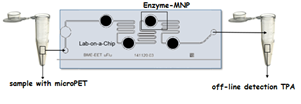
3. Development of immobilized enzymatic system with applicability for microPET detection:
several functional co-immobilization strategies of
PET-degrading enzyme combinations on smart, functionalized nanosupports
will be fine-tuned by engineering the immobilization process
towards its applicability in microfluidic systems,
providing a sensitive, enzymatic system for the detection of microPET from its water-based solutions.
|
ENZYMATIC DEGRADATION OF PET
MICROPARTICLES |
ENZYMATIC DETECTION OF PET
MICROPARTICLES |
|
|
|